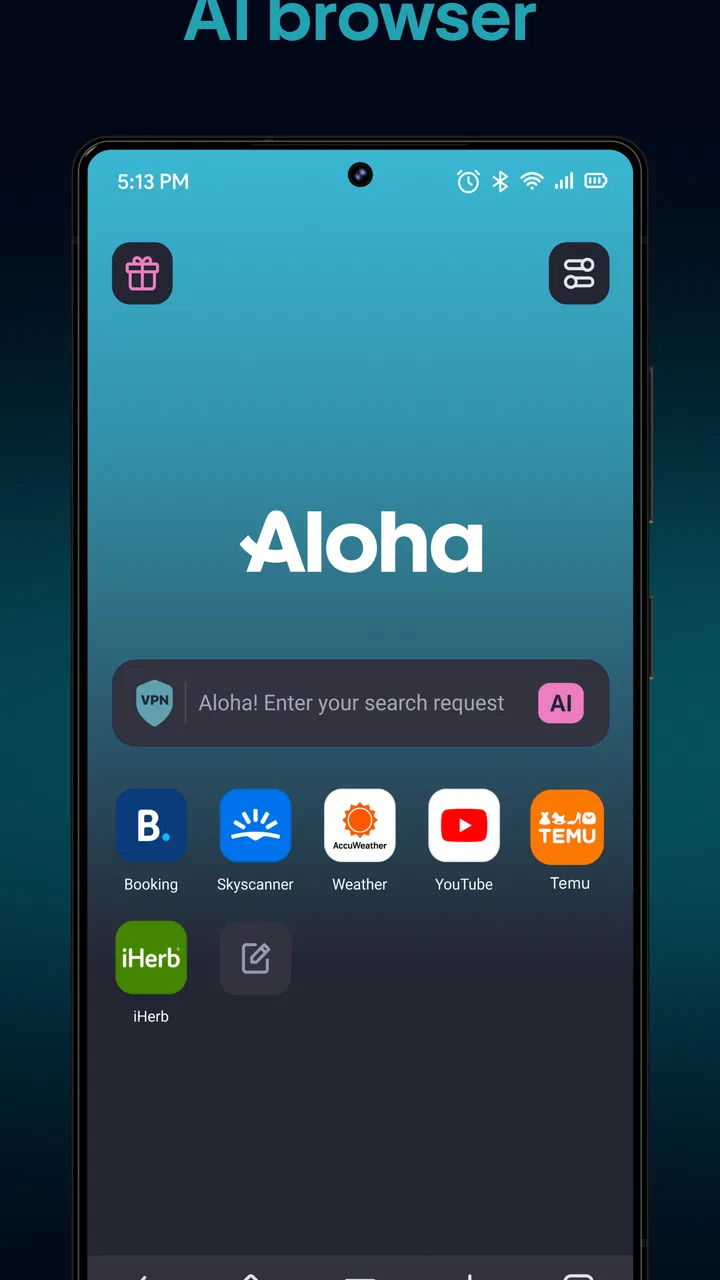
Aloha Browser - Private VPN
- 4.8
- Rating
- 10.00M
- Installs
- Free
- Price

 Analysis by App-foxy
I started using Aloha Browser - Private VPN because I wanted a more private way to browse on a device that other people in my household also use. It is a free productivity app from Aloha Mobile, but I would not describe it as a simple replacement for every browser. Its appeal comes from putting private browsing tools, ad blocking, and a secure connection in one place, which can make everyday web use feel less exposed and less cluttered.
My experience was most useful in shared situations: checking a personal account after someone else had used the tablet, opening a website without carrying over ordinary browsing history, or reading pages where aggressive advertising made navigation unpleasant. The app is available for Everyone, and its store presence shows a 4.7 average from around 356 thousand ratings, with more than 10 million installs. Those figures suggest that it has reached a broad audience, but popularity alone does not make it the right browser for every household.
How Aloha Browser fits into a shared household
The first thing I noticed is that a private browser can solve a very specific household problem: separating browsing sessions without asking everyone to change how they use the device. On a shared phone or tablet, ordinary browsing can leave behind open tabs, history, saved site data, and suggestions that appear at inconvenient times. Aloha Browser gives me a place to handle more personal browsing without mixing it as visibly with the next person’s session.
You May Also Like

 Blood Strike: 2.5 Anniversary
Blood Strike’s Loadouts Turn Every Drop Into a Tactical Gamble
A close look at Blood Strike’s custom loadouts: how fast access to signature weapons reshapes its battle royale rhythm, rewards preparation, and narrows the gap between fights.

 Pandora - Music & Podcasts
Pandora’s Music Is Easy to Start, but Harder to Recover
Pandora’s strength is its low-effort path from a seed to a station. Its weak spot is how much confidence it asks you to place in connection, setup, and quiet recovery.

 8 Ball Pool
 Is Built on Rivalries, Rematches, and Routine
A close look at the rivalries, rematches, shared routines, and unanswered safety questions that turn a quick pool match into a persistent mobile community.

 Samsung Music
’s Quiet Strength Is Playing What You Already Own
Its reach comes less from spectacle than from dependable access to a personal library. That simplicity is both the app’s strongest retention engine and its ceiling.

 AccuWeather: Weather Radar
AccuWeather Review: A Quick, Clear Forecast for Everyday Decisions
For everyday plans, the best forecast is the one you can understand quickly. AccuWeather makes rain timing, radar, and local conditions easy to act on, with a few trade-offs.

 Hill Climb Racing
Why Hill Climb Racing Still Turns Crashes Into One More Run
A tiny car, a bumpy hill and one more upgrade: Hill Climb Racing keeps resurfacing because its simple chaos makes every near-miss feel personal.
More From Our News Desk



That does not turn one device into several fully independent user accounts. I still treat the phone or tablet itself as shared territory. Notifications from other apps, downloaded files, saved passwords, and the wider operating-system environment remain separate concerns. This distinction matters. The browser can help me keep a browsing session private, but it should not be presented as a complete household separation system.
A realistic example is a family tablet used in the living room. One person may use the regular browser for school research, another may check a personal shopping account, and I may want to read sensitive work material without leaving a trail in the browser used by everyone else. In that situation, Aloha Browser is convenient because I can choose it for the session that needs more separation instead of changing the household’s main browser setup.
I also found ad blocking useful in this shared-device context. Pages that are difficult to read because of banners, pop-ups, or crowded layouts become easier to scan. That is not merely cosmetic. On a smaller screen, fewer distractions can reduce accidental taps, which is especially helpful when a child or an older relative is trying to follow a page. Still, ad blocking is not a guarantee that every website will behave perfectly; some sites may depend on advertising scripts or may ask the visitor to adjust privacy settings.
Starting without overcomplicating the setup
The app is free to install, which makes trying it low-risk from a cost perspective. Its current version is 8.4.3, and it requires at least OS 10. I would check the operating system on an older household device before planning around it, because compatibility is a practical issue when a tablet is passed between family members for years.
My advice is to decide its role before making it the default browser. If the goal is occasional private browsing, install it as a second option and keep the familiar browser for general links. If the goal is to move all browsing into one app, spend time testing the websites that matter most to the household: banking, school portals, work dashboards, video services, shopping pages, and sign-in screens.
This trial approach prevents a common mistake. Privacy-focused tools can be excellent for certain sessions but inconvenient when a website expects a standard browser environment. A page may load differently with blocking enabled, a login may need an extra step, or a service may ask for permission again. I prefer discovering those quirks before someone needs the device urgently.
The app includes in-app purchases ranging from $0.99 to $109.99 per item. Because the basic download is free, I would pay attention to what is offered during use rather than assuming every privacy-related option is included without charge. On a shared device, that conversation is worth having in advance, particularly if several people can access the same app store account or payment method.
Keeping personal boundaries clear
Aloha Browser can create a useful boundary around browser activity, but the boundary is only as strong as the habits around it. I would avoid handing the device to another person while a personal session is open, and I would close sensitive tabs before switching users. Private browsing is not a substitute for locking the device or protecting individual accounts.
I also recommend separating browsing choices from account choices. Using a private browser does not mean I should sign into every account on a shared tablet. If I do sign in, I treat that account as active on the device until I deliberately sign out. The browser can reduce local traces from a session, but it cannot make an account immune to mistakes such as leaving a page open or saving a credential where someone else can reach it.
For household coordination, a simple routine works better than complicated rules. I would tell other users which browser is intended for shared research and which one I reserve for personal sessions. That way, a family member is less likely to reopen a private tab by accident, and nobody assumes that a browser window left on the screen is available for casual use.
This is also where Aloha Browser is less suitable as a universal family browser. If everyone needs synchronized bookmarks, shared passwords, or a single consistent history across devices, a mainstream browser tied to the household’s existing account system may be easier. Aloha’s strengths are privacy and reduced clutter, not necessarily the broadest collaboration workflow.
Privacy tools in everyday use
The store summary highlights incognito browsing with ad blocking, protection for web activity, and a secure connection. In practice, I see those as separate benefits rather than one magical privacy switch. Incognito-style browsing helps keep a session apart from ordinary history. Ad blocking changes how pages load and what appears on them. A secure connection can be useful when I am concerned about browsing over an untrusted network.
I would not treat the secure connection as permission to ignore basic account security. Strong, unique passwords, device locking, and careful handling of verification codes still matter. A private connection can protect part of the route between the device and the web, but it does not make a suspicious website trustworthy or prevent me from giving information to the wrong service.
One of the more useful workflows I found is to use the app selectively rather than automatically. I might use it when reading a topic I do not want influencing ordinary suggestions, when connecting to public Wi-Fi, or when a page is overloaded with advertising. For routine browsing on a trusted home network, I may prefer the browser that already contains my organized bookmarks and account sessions.
That selective approach also makes troubleshooting easier. If a website fails in Aloha Browser, I can compare it with the regular browser instead of wondering whether the network, the website, or the privacy tools caused the problem. This is a small habit, but it saves time in a household where one person may blame the tablet while another is trying to complete an important form.
Another practical tip is to use the browser’s privacy-oriented session for reading and research, then move only the necessary information to the shared workflow. For example, I can read several product pages privately, make a decision, and later place the final order through the household’s established account. That limits unnecessary mixing of personal browsing with a shared shopping profile.
What younger users and older relatives should understand
The Everyone age rating makes the app approachable for a wide audience, but an age label is not the same as a complete supervision system. I would be comfortable introducing it to a teenager as a browser with privacy tools, provided we also discuss responsible browsing, account safety, and the difference between privacy and secrecy. I would not rely on it alone to manage what a child can access.
For younger users, ad blocking may reduce distracting or misleading page elements, but it cannot replace an adult’s guidance. A child can still reach unsuitable material through links, searches, messages, or other apps on the device. If a household needs content filtering, activity oversight, or formal parental controls, those needs should be handled with tools designed for that purpose rather than assumed to come from this browser.
With older relatives, the conversation is different. The cleaner page layout can make websites less intimidating, and a secure connection may be reassuring when they use public networks. However, privacy language can also create false confidence. I would explain that the app helps with browsing conditions, not with identifying scams. A convincing fake banking page remains dangerous even when opened through a privacy-focused browser.
Shared use also raises the question of trust between adults. A browser that keeps activity less visible can be valuable for personal boundaries, but it should not be used to create a false impression that a device is being monitored when it is not, or that every action is automatically protected. In my view, the healthiest arrangement is clear ownership: each person knows what the browser does, what it does not do, and when the device should be handed back with sessions closed.
Where it beats ordinary browser habits
Compared with a standard browser used without any privacy adjustments, Aloha Browser feels more purposeful. I do not need to assemble separate ad-blocking tools and then remember to activate a private mode for a particular task. The combination is the main reason I would recommend trying it. It is especially appealing to someone who wants a dedicated option for sensitive or distraction-heavy browsing without changing every setting in their main browser.
It can also be more comfortable than repeatedly clearing history in a conventional browser. Manual cleanup is easy to forget, and clearing everything may remove useful browsing information for other household members. Keeping private sessions in a separate app reduces that conflict. I can leave the main browser’s shared research intact while using Aloha Browser for activity I do not want mixed into it.
The trade-off is that a second browser creates its own learning curve. Bookmarks, logins, tabs, and habits may be split between apps. If I use both carelessly, I can end up searching for a saved page or wondering where a session was opened. The solution is not difficult, but it requires a deliberate rule about which browser handles which type of task.
Aloha Browser is also not automatically better than a mainstream browser for productivity in the narrow office sense. If my day depends on deep integration with a desktop browser, shared workspaces, synchronized passwords, or a company-managed environment, the familiar platform may be more efficient. I would choose Aloha for privacy-sensitive browsing and cleaner web pages, not because it replaces every browser feature I already use.
Small frictions that affect the decision
The biggest limitation for me is the gap between a private browsing experience and complete privacy. The app can improve the browser session, but the device, accounts, downloads, screenshots, and other applications still matter. Anyone deciding whether to use it should think in terms of reducing exposure, not becoming invisible.
The second friction is website compatibility. Blocking can improve a page, but it can also interfere with sites that use scripts for navigation, payments, sign-in, or embedded content. When something does not work, I would first check whether the page offers a privacy-friendly alternative, then temporarily adjust the browsing approach only if I trust the site. I would not disable protections casually on an unfamiliar page.
The third is household confusion. A separate browser is helpful only when people know why it exists. Without that explanation, one person may assume it is the default browser, another may leave a personal session open, and a third may search through the wrong app for a saved page. A two-minute explanation at installation is more valuable than silently adding it to the home screen.
Finally, the purchase range deserves attention. The app costs nothing to download, but optional items can become relevant depending on how the household uses it. I would review any purchase screen carefully and avoid assuming that a feature described in broad privacy language has the exact behavior I expect. Privacy is too important to evaluate through vague impressions alone.
My household verdict
After using it as a dedicated privacy-oriented browser, I see Aloha Browser - Private VPN as a strong companion to an ordinary browser rather than an automatic replacement for it. I like the combination of private sessions, ad blocking, and secure-connection tools, especially on a shared device where browsing boundaries are otherwise easy to blur.
I would recommend it to adults who want a separate place for personal browsing, people who regularly use public Wi-Fi, and anyone frustrated by cluttered pages. It is also a sensible option for a household that wants clearer browser boundaries without creating separate devices. The most effective setup is intentional: decide which activities belong there, close sessions when switching users, and explain its limits to everyone who uses the device.
I would skip it as the main family browser if synchronization, shared account management, or formal child supervision is the priority. In those cases, a browser already connected to the household’s wider device ecosystem may be more practical, while dedicated parental-control tools are better for age-based restrictions.
For my own use, the best reason to keep Aloha Browser installed is not that it promises to solve every privacy problem. It is that it makes a few valuable habits easier: separating personal sessions, reducing advertising clutter, and being more deliberate about browsing on shared or public devices. Used with realistic expectations, it earns its place as a practical second browser for a household that values both convenience and personal space.
FAQs for Aloha Browser - Private VPN
01What are the main features of Aloha Browser?
Aloha Browser is known for its comprehensive privacy features, including a built-in VPN for secure browsing, ad-blocking capabilities, and an encrypted file manager to store your downloaded content safely. The browser also supports VR and 360° video playback, making it versatile for both security and entertainment purposes.
02How does Aloha Browser ensure user privacy and security?
Aloha Browser prioritizes user privacy with its built-in VPN, which encrypts your internet traffic, ensuring that your browsing activity remains private and secure from prying eyes. Additionally, it blocks ads and trackers by default, further enhancing privacy and reducing data consumption while browsing.
03Is Aloha Browser free to use, or does it have a premium version?
Aloha Browser is free to download and use. However, it offers a premium version called Aloha Premium. This version includes additional features like unlimited VPN usage, auto-start for the VPN, and advanced privacy options, providing a more robust experience for users who require enhanced security.
04Can Aloha Browser be used on both Android and iOS devices?
Yes, Aloha Browser is available for both Android and iOS platforms. It offers a consistent experience across devices, allowing users to enjoy its privacy features and media playback capabilities regardless of their operating system. The app is designed to be intuitive and user-friendly on both platforms.
05Does Aloha Browser support file downloads, and how does it handle them?
Aloha Browser supports file downloads and provides an encrypted file manager to securely store your downloaded files. This feature ensures that your files are protected from unauthorized access. The browser also allows you to manage and organize your files directly within the app, offering a seamless user experience.
Pros
- Built-in VPN for secure browsing
- Ad blocker enhances page load speed
- Supports multiple tabs smoothly
- Download manager for easy file access
- User-friendly interface with night mode
Cons
- Limited free VPN data per month
- Occasional crashes on heavy sites
- No built-in password manager
- Lacks advanced customization options
- Some features require premium upgrade

Aloha Browser - Private VPN
Gallery